Why Industrial Gas Measurement Matters
Industrial gases are essential to welding, cutting, heat treatment, food packaging, electronics, chemical processing and many other production processes. However, many plants only know the total gas purchase volume and cannot determine where, when or how the gas is consumed.
Common Challenges
· No consumption data for individual departments or production lines
· Gas costs cannot be accurately allocated
· Leaks and abnormal consumption remain undetected
· Supply pressure and flow fluctuate during production
· Manual meter reading is inefficient and error-prone
· Historical data is unavailable for analysis
· Existing meters are unsuitable for low, fluctuating or wet gas flow
What the Solution Measures
The system can continuously monitor:
- Instantaneous gas flow
- Standard or mass flow
- Accumulated gas consumption
- Gas pressure
- Gas temperature
- Flow and pressure trends
- Abnormal consumption and threshold alarms
- Consumption by department, line or machine
Typical Measurement Architecture
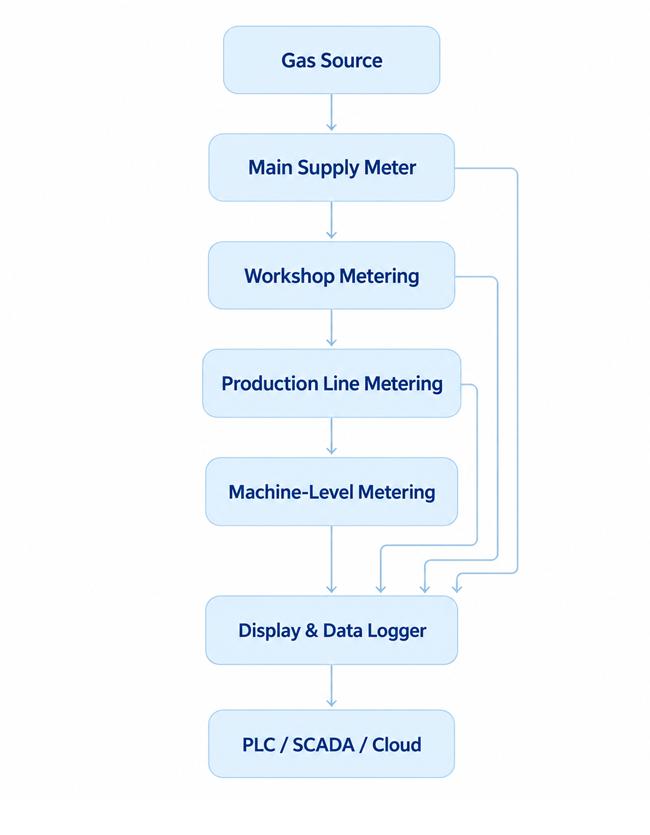
A hierarchical measurement structure makes it possible to compare total supply with downstream consumption. The difference between upstream and downstream values can help identify unmetered use, gas leakage or abnormal consumption.
Selecting the Right Measurement Technology
| Application condition | Recommended technology | Main advantage |
| Clean, dry industrial gases | Thermal mass flow meter | Direct standard/mass flow measurement; wide turndown ratio |
| Large-diameter pipelines | Insertion thermal mass or Pitot tube | Lower installation cost and suitable for large pipes |
| Small pipelines and machine-level use | Inline or compact thermal mass meter | Compact installation and sensitive low-flow measurement |
| Wet or contaminated gases | Pitot tube or vortex flow meter | Better adaptability to demanding gas conditions |
| High temperature, pressure or hazardous areas | Vortex or explosion-proof meter | Robust construction and industrial-grade protection |
| Highly fluctuating consumption | Wide-range thermal mass meter | Captures both low and peak consumption |
Oxygen, hydrogen, natural gas and other special or hazardous gases require confirmation of wetted materials, sealing, pressure rating, explosion protection and gas-specific calibration before product selection.
Recommended FIX Instruments Products
F211x / F221x Insertion Thermal Mass Flow Meter
Recommended for clean and dry industrial gases in medium- and large-diameter pipelines.
· Measures standard flow, mass flow, accumulated consumption and gas temperature
· Wide measuring range and high sensitivity at low flow
· No moving parts and low pressure loss
· Suitable for DN20–DN1000 pipelines depending on configuration
· RS485 Modbus RTU, 4–20 mA and pulse output
· Optional installation under pressure through a ball valve
F212x / F222x Inline Thermal Mass Flow Meter
Recommended for smaller pipelines, production lines and equipment-level gas consumption measurement.
· Integrated pipe-section design
· Stable installation conditions
· Suitable for department, line or machine-level metering
· Direct consumption measurement without separate temperature and pressure compensation under specified conditions
F235x Compact Thermal Mass Flow Meter
Recommended for small gas lines, laboratory equipment, OEM systems and individual gas-consuming machines.
· Compact structure
· Measuring range up to 0.02–3000 SLM, depending on configuration
· Suitable for low-flow and point-of-use measurement
Recommended for large pipelines and wet or challenging gas conditions where thermal measurement may not be suitable.
· Suitable for large pipeline measurement
· Low permanent pressure loss
· Adaptable to wet-gas applications
Recommended for wet gases, higher-temperature applications and demanding industrial environments.
· Measures gas, steam and liquid
· Integrated temperature and pressure compensation
· No moving parts and low pressure drop
· Resistant to vibration and electromagnetic interference
· Explosion-proof design available
F401x / F402x Pressure Transmitter
Monitors gas supply pressure and helps identify excessive pressure loss, unstable supply or insufficient pressure at critical equipment.
F402x is recommended where explosion-proof construction is required.
F351x Multifunction Display and Data Logger
Collects flow, pressure and temperature data from multiple measurement points for local display, historical recording and alarm management.
F0110 Wi-SUN / F0112 4G Communication Module
Used where cabling is difficult or remote data transmission is required.
Data Integration and Monitoring
Measurement data can be transmitted to existing systems through:
- Modbus RTU / RS485
- 4–20 mA
- Pulse output
- Wi-SUN industrial wireless network
- 4G remote communication
- PLC, SCADA, BMS or energy-management platforms
Transparent Gas Consumption
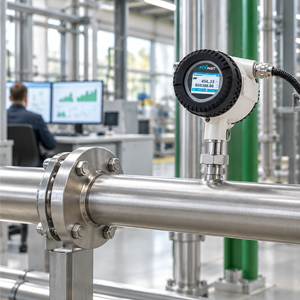
Transparent Gas Consumption
Know exactly where and how industrial gases are consumed.
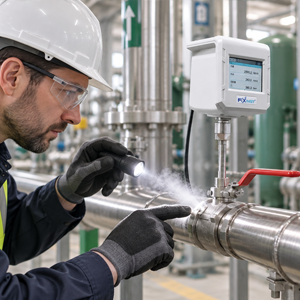
Reduced Gas Waste
Identify unexpected base loads, excessiveconsumption and potential leakage.
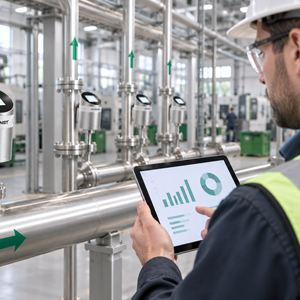
Accurate Cost Allocation
Allocate gas costs by workshop, line,machine, shift or production batch.
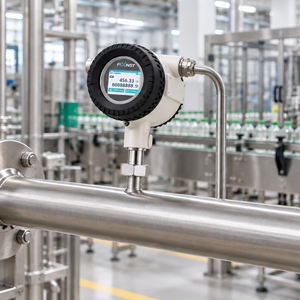
Stable Production
Monitor flow and pressure to prevent insufficientgas supply from affecting product quality orproduction capacity.
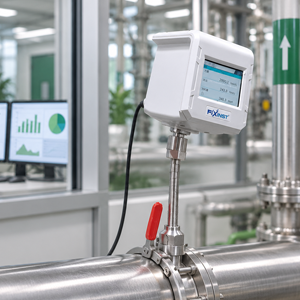
Data-Based Optimization
Use historical consumption data to optimize gas supply, production scheduling and
equipment operation.
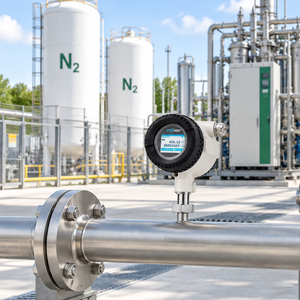
Easier System Expansion
Use real consumption and peak-flow data to evaluate pipelines, tanks, generators and supply capacity.